Market Analysis
Cape Coral Real Estate Trends: Where the Market Is Heading in 2026
Data-driven analysis of the Southwest Florida real estate market.
8 min readMarch 25, 2026
Market Analysis
Old Naples, Park Shore, Port Royal, and Pelican Bay have moved in different directions since the spring close. Here is where the data has actually diverged.
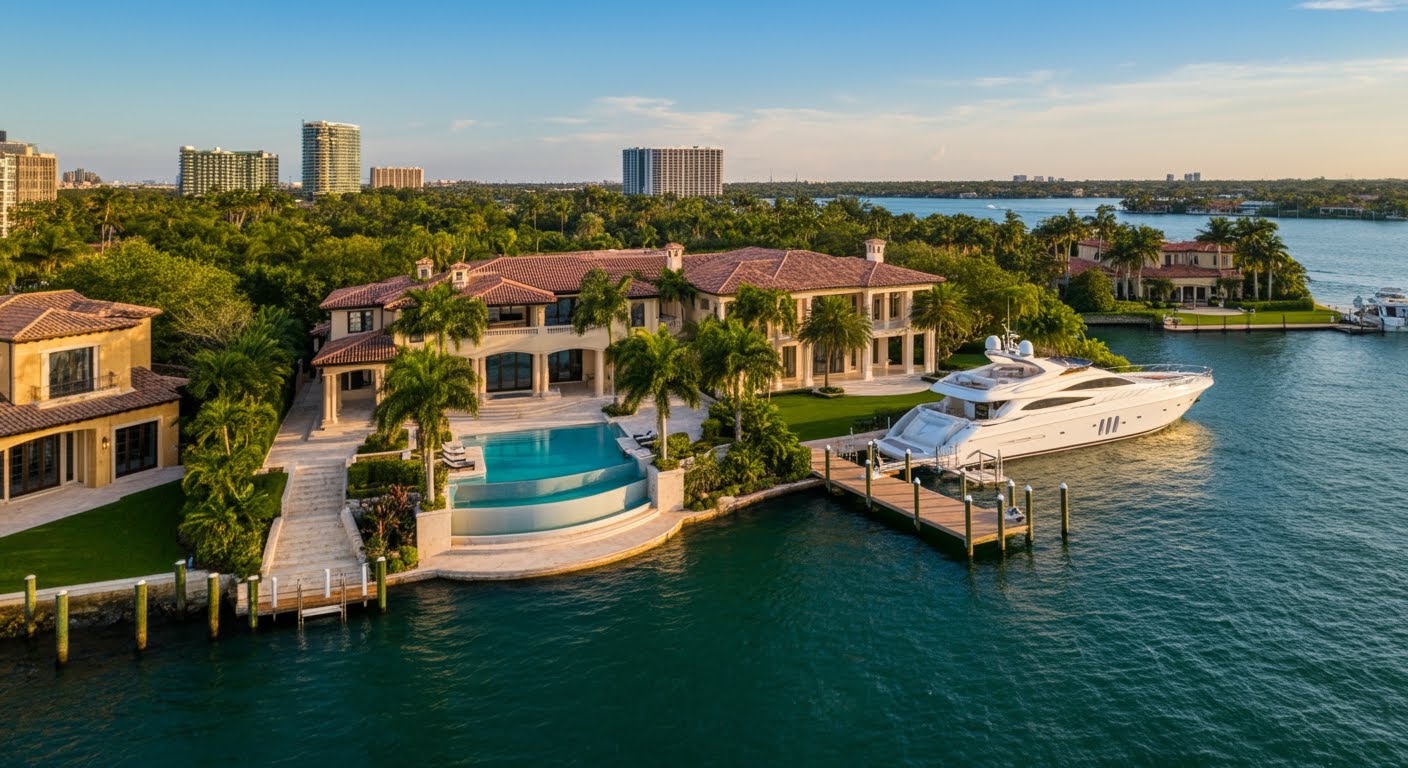
Naples Luxury Real Estate Heading Into Fall 2026: A Submarket Read — illustrative photo
If you have been watching the Naples luxury market from a distance, you have probably seen headlines that treat it as one market. It is not. Heading into fall 2026, the $2M-plus segment in Naples has fractured into submarkets that are behaving quite differently from each other — and from where they were at the end of the spring selling season.
What follows is a submarket-level read on where inventory sits, how days-on-market have shifted, who is actually buying at different price bands, and what the insurance market looks like for the highest-value coastal homes. It is not a prediction. It is a snapshot of what the data and the conversations with buyers and sellers are showing right now, and a framework for thinking about what it means if you are on either side of a transaction.
The spring 2026 close was uneven. Some submarkets cleared through their strongest inventory; others carried listings into the summer that are still active today.
Old Naples has been the tightest of the four. Inventory in the $3M-$8M single-family range remains constrained because the physical footprint is what it is — a small number of blocks between the Gulf and the bay. New listings have come on through summer at a modest pace, and the standing inventory has turned over enough that active count has stayed roughly flat since spring. Sellers here are still generally testing prices at or slightly above spring comparables.
Park Shore is a different story. The high-rise condo inventory along Gulf Shore Boulevard has built up meaningfully since spring, particularly in the $2M-$4M band. A combination of estate sales, owners relocating, and buyers who purchased at the peak deciding to reset has pushed active condo listings to levels not seen in a few years. Single-family in Park Shore is tighter, but the condo picture is what is driving the submarket average.
Port Royal sits at the top end and moves on its own clock. Active listings above $10M are up modestly from spring, but transaction velocity is low enough that a single closing meaningfully changes the statistics. The $5M-$10M segment in Port Royal and Aqualane Shores has more standing inventory than it did in April, and price adjustments have become more common — not dramatic, but visible.
Pelican Bay is the most bifurcated. High-rise Gulf-front units are moving at a reasonable pace when priced against current comps, while mid-rise and low-rise inventory in the interior of the community has lengthened. Single-family in Pelican Bay Woods has held up better than the mid-rise condos.
Days-on-market tells you where the friction is. Heading into fall 2026, the pattern looks roughly like this across the four submarkets:
Where prices are normalizing fastest is in the Park Shore condo market and the Pelican Bay mid-rise segment. Those are the two areas where supply has caught up with demand most clearly. Old Naples single-family remains the most price-resilient of the four submarkets, and Port Royal is in its own category where individual property characteristics matter more than submarket-level averages.
The composition of the buyer pool has shifted noticeably between the $2M-$5M segment and the $5M-plus segment, and it is worth understanding the difference before peak season starts.
In the $2M-$5M band, the buyer pool this fall skews toward relocators — families and semi-retirees moving from the Northeast, Midwest, and California who are looking at Naples as a primary or long-term secondary residence. This buyer is more rate-sensitive than the ultra-high-end buyer, more likely to be financing at least a portion of the purchase, and more willing to walk away from a property that does not appraise or that has insurance issues. They are also more likely to compare Naples to Bonita Springs or Estero on total cost of ownership.
In the $5M-plus band, the buyer pool is narrower and more discretionary. These are often second, third, or fourth home purchases. Fewer of these buyers are financing, and the ones who are typically have flexibility about how they structure the transaction. They are less rate-sensitive on a monthly-payment basis but more sensitive to the qualitative factors — whether the property will hold value, whether the community reputation is intact, whether insurance is actually obtainable at a reasonable premium.
Heading into fall 2026, buyer inquiries in the $5M-plus range have been steady but not urgent. The $2M-$5M inquiries have picked up earlier than they did last year, which suggests some seasonal buyers are trying to get ahead of the January-February crowd.
The cash-versus-financed mix in Naples luxury varies sharply by price band, and it explains a lot about why different segments have responded differently to the rate environment.
Below $3M, financed transactions are common and the buyer pool moves with mortgage rates. When rates drift up, this pool contracts. When rates settle, it expands. This is why the $2M-$3M single-family and $2M-$3M condo segments have been the most rate-sensitive parts of the Naples luxury market.
Between $3M and $8M, the mix is closer to half-and-half. Many buyers in this range use financing strategically — jumbo loans, portfolio loans from private banks, or asset-backed lines — rather than because they need it. Rate movement affects the marginal buyer but does not shut down the segment.
Above $8M and particularly above $10M, cash and cash-equivalent transactions dominate. Rate sensitivity in this band is minimal in the traditional sense. What matters more is the opportunity cost of the capital — whether the buyer sees the property as a better use of funds than alternative investments. That is a very different calculation, and it moves on different variables than mortgage rates. When broader markets are volatile, this buyer sometimes pulls back not because financing got harder but because they are reassessing their overall position.
None of this is investment advice, and the specifics of how a buyer structures a purchase are the kind of thing to work through with a CPA and a private banker. But understanding the mix helps explain why the $2M-$3M segment feels softer than the $8M-plus segment even in a market where both have more inventory than they did.
Insurance is now a first-order factor in Naples luxury transactions, particularly for anything Gulf-front, bay-front, or in a VE flood zone. It cannot be treated as a checkbox item to handle after contract.
For homes above roughly $5M in coastal Naples, the standard admitted homeowners market is largely not writing new business. Coverage is coming primarily from the surplus lines market — carriers like the Chubb Masterpiece program, PURE, Cincinnati, and several Lloyd's-backed syndicates that specialize in high-value coastal risk. Citizens Property Insurance is generally not an option at these values because Citizens has coverage limits that fall below the replacement cost of most ultra-high-value homes.
What has shifted since spring is that a few of the surplus lines carriers have tightened their underwriting on Gulf-front properties specifically. Roof age, construction type, elevation, hurricane shutter documentation, and prior claim history all matter more than they used to. Homes with new impact glass, elevated construction, and clean claim history are still insurable at premiums that are high but not shocking for the value. Older Gulf-front homes with legacy construction are increasingly difficult to place, and premiums when coverage is available can run 1.5% to 2.5% of insured value annually — sometimes more.
Flood insurance at these values is a separate conversation. NFIP caps out well below the value of these properties, so buyers are layering private flood coverage on top. That market has become more competitive over the last two years, which is one of the few pieces of genuinely good news.
The practical implication for both buyers and sellers: get an insurance quote in hand before you get to the inspection period. On the buy side, an unobtainable or extraordinarily expensive policy can kill a deal after the earnest money is at risk. On the sell side, having a current insurance binder or at least a preliminary quote package ready for serious buyers shortens the diligence timeline and reduces the chance of a late-stage renegotiation.
If you are a seller in the $2M-$5M Park Shore condo or Pelican Bay mid-rise segment, price to the last 60 days of closings, not to spring peak. The buyers coming through now are informed, comparing multiple listings, and unwilling to overpay. A property priced correctly at listing generally still transacts inside a reasonable window; a property priced 8-10% above the current comp set typically sits and eventually reduces, often to a level below where it would have transacted with correct initial pricing.
If you are a seller in Old Naples single-family or the top end of Port Royal, you have more flexibility. The buyer pool is thinner but so is the competitive inventory. Marketing time matters less; presentation and preparation matter more.
If you are a buyer heading into peak season, the negotiating room is real in some segments and much narrower in others. A Park Shore condo listed at $3.5M that has been on 90 days is a different conversation than an Old Naples single-family listed at $5M last week. Understanding which submarket you are in — and what the recent trajectory has actually been — changes what a reasonable offer looks like.
For anyone thinking about a move within Naples or into it from another market, the current baseline is worth understanding before you set expectations. I put together specific comparables and submarket data for clients on a case-by-case basis, and if you want a read on where a particular property or building sits, that starts with a conversation. You can find more about how we work with buyers and sellers in Naples, or reach out through the contact page if you want to walk through your specific situation. If you are on the sell side and want a current valuation as a starting point, the home value tool will get you a rough number and I can refine it from there.
Fall in Naples is when the market wakes back up. Whether it wakes up strong or measured depends less on any single headline number and more on which submarket you are in and how well matched the pricing is to the current buyer pool. That is the honest read heading into September.
Equal Housing Opportunity. Freddy Baez · Florida Broker BK3274734 · The Baez Collective at eXp Realty. Information here is general guidance, not legal, tax, or investment advice — please consult a qualified professional for your specific situation.
— Freddy & Josey
Frequently Asked
Explore These Cities
The SWFL Market Letter
Market notes and neighborhood reads from Freddy & Josey — written for SWFL homeowners, buyers, and the curious. No spam, no pressure.
Market Analysis
Data-driven analysis of the Southwest Florida real estate market.
Market Analysis
Data-driven analysis of the Southwest Florida real estate market.
Market Analysis
Data-driven analysis of the Southwest Florida real estate market.
Local team. Licensed in Florida. En español también.