Niche Guides
Divorce and Real Estate in Florida: How to Handle the House
Specialized real estate guidance tailored to your situation.
7 min readMarch 25, 2026
Niche Guides
Physician relocations move on their own timeline — start dates, call schedules, and loan products that behave differently. Here's how to think through the SWFL version of that move.
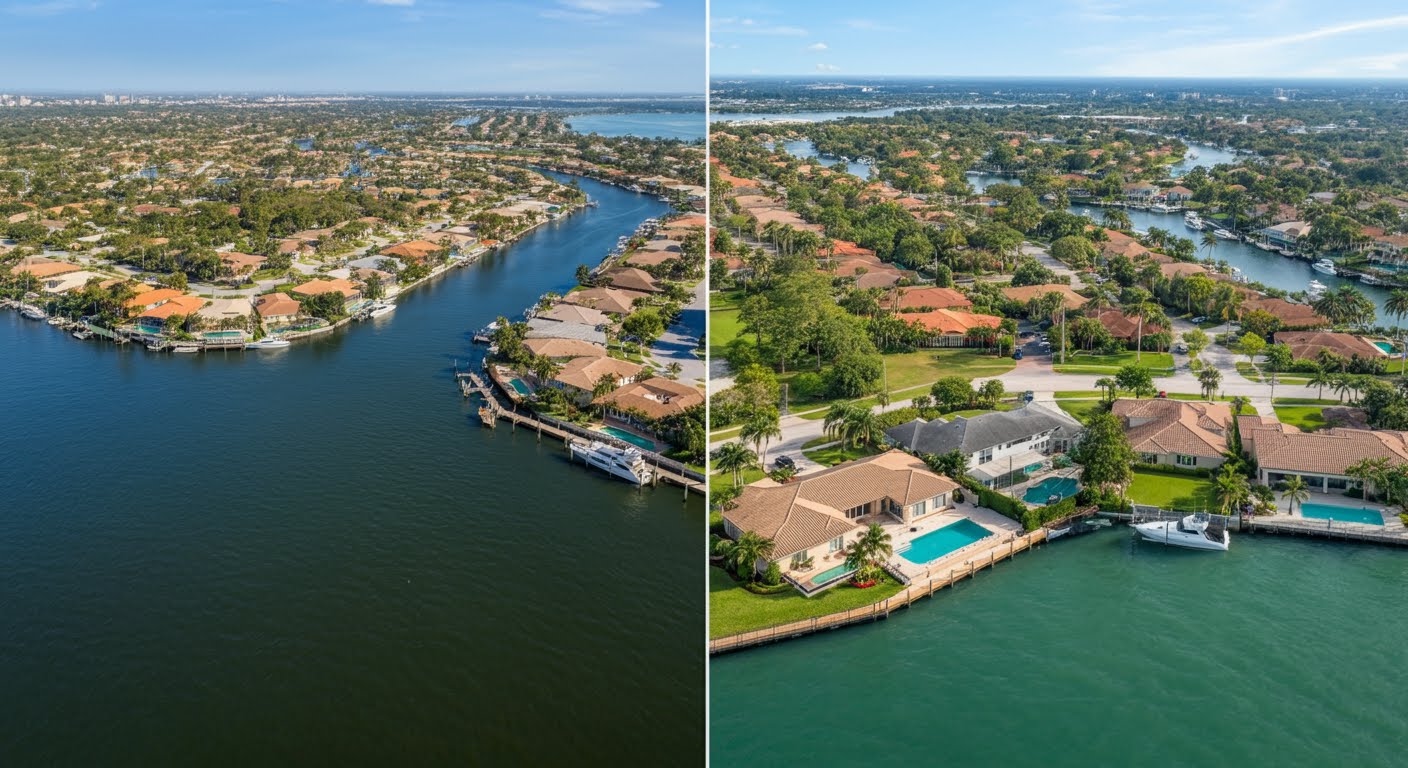
Aerial view of a Southwest Florida hospital campus surrounded by residential neighborhoods
Physician relocations don't look like other relocations. The start date is fixed months in advance, the loan products behave differently than what your peers used, and the neighborhood question isn't really about the house — it's about whether you can get to the hospital at 2 a.m. without hating your life. Add Southwest Florida's specific quirks — three separate hospital systems in three counties, hurricane insurance costs that surprise most out-of-state buyers, and a seasonal traffic pattern that transforms every commute between November and April — and there's real value in slowing down.
What follows is a practical framework for physicians evaluating a move to Lee, Collier, or Charlotte county. It's not a pitch for buying immediately. In many cases, the smart move is renting first. Here's how I'd think through it.
Most physicians relocating to SWFL end up considering a physician loan product rather than a conventional mortgage. The core features are consistent across the lenders that offer them:
What they don't cover, and where physicians get surprised: physician loans generally require the property to be a primary residence, not an investment. They usually cap loan amounts even for high earners, so a $2.5 million Naples home may push you into jumbo territory with a larger down payment. And the interest rate on a physician loan is often modestly higher than a conventional loan with 20% down — you're paying for flexibility, not free money.
Rate spreads vary by lender and week, but expect roughly 0.125% to 0.5% above conventional pricing in exchange for the low down payment and no PMI. On a $700,000 loan, that's real money over 30 years, but it's often the right trade for someone who'd otherwise have to liquidate investments or wait years to save a 20% down payment.
Where you buy or rent should be driven by where you work, because SWFL's hospital systems don't overlap the way they do in denser metros. The three main systems each dominate a specific geography.
Lee Health is the largest system in Lee County and operates several hospital campuses including Gulf Coast Medical Center and HealthPark in south Fort Myers, Lee Memorial and Golisano Children's Hospital in central Fort Myers, and Cape Coral Hospital. If you're joining a Lee Health group, your call radius almost certainly includes at least two of these campuses, and the geography of Fort Myers, south Fort Myers, and Cape Coral all become viable — with meaningful differences in commute during season.
NCH Healthcare System (Naples Comprehensive Health) is Collier County's dominant system, with the Baker Hospital downtown Naples campus and the North Naples campus off Immokalee Road. Physicians at NCH are almost always looking at neighborhoods within Collier County — Naples proper, North Naples, or Bonita Springs at the northern edge. Reverse-commuting from Estero or Fort Myers into Naples during season is punishing.
HCA Florida operates several facilities in the region including HCA Florida Fawcett Hospital in Port Charlotte and other affiliated campuses. If you're joining an HCA group in Charlotte County, Port Charlotte, Punta Gorda, and Venice become the natural housing conversation.
The practical implication: don't fall in love with a house in Naples and then realize your practice is at Cape Coral Hospital. The distance is roughly 45 miles, and during peak season it can be a 90-minute drive each way. If you're taking call, that's not sustainable.
The single most useful question I ask physician clients is: How often will you be driving to the hospital between 10 p.m. and 6 a.m., and what's the maximum response time in your contract?
If you're 20 minutes from the hospital in normal traffic, you're probably 20 minutes at 2 a.m. as well — SWFL doesn't have significant nighttime congestion. But daytime commutes during season (roughly mid-November through mid-April) are a completely different animal. A 20-minute off-season commute from a home in Cape Coral to Gulf Coast Medical Center can stretch to 45 or 50 minutes in February. US-41 through Naples and Bonita Springs can double in travel time during peak season.
Neighborhoods that work well for Lee Health physicians who want reasonable commutes across all seasons: south Fort Myers (Gateway, Daniels Parkway corridor, Whiskey Creek), central Fort Myers (McGregor corridor for HealthPark access), and southeast Cape Coral for those working at Cape Coral Hospital. If you're at Golisano or Lee Memorial, the historic McGregor corridor and downtown-adjacent neighborhoods keep you close.
For NCH physicians: North Naples (Pelican Bay, Vineyards, the Livingston Road corridor) works well for the North Naples campus. For the downtown Baker campus, Old Naples, Park Shore, Moorings, and the neighborhoods east of US-41 in central Naples keep you within a 10 to 15 minute drive even in season. Bonita Springs is workable for North Naples but adds significant time to downtown.
For HCA physicians in Charlotte County: Punta Gorda Isles and Burnt Store Isles are the classic waterfront options; Deep Creek and the newer developments off I-75 offer more space at lower prices. Commute times within Charlotte County stay reasonable year-round because seasonal traffic is lighter here than in Naples or Fort Myers.
For physicians on a one-year contract, or anyone uncertain about long-term fit with a practice, renting for the first year is often the right call. Not always — but often.
Reasons to rent first:
Reasons to buy immediately: you have a multi-year contract, you know the market, you have a clear neighborhood target based on the hospital campus, and you'd rather pay a mortgage than rent. Physician loans specifically enable this — the 60-to-90-day pre-start closing is designed for exactly this scenario.
A few things about buying in Southwest Florida that don't come up in relocation guides for other regions:
Insurance is a bigger line item than most physicians expect. A $900,000 home in Lee or Collier County can carry annual homeowners insurance of $6,000 to $12,000, plus flood insurance of $1,500 to $4,000 for properties in Zone AE, plus wind coverage which may or may not be bundled depending on the carrier. Post-Ian, many standard carriers pulled out of the market and Citizens Property Insurance (the state-backed insurer of last resort) writes a substantial share of SWFL policies. Get real insurance quotes before you're under contract, not after.
The Homestead Exemption and Save Our Homes cap matter more here than in most states. Once you establish Florida residency and file your homestead application by March 1, your assessed value increases are capped at 3% per year regardless of market appreciation. Over a decade at a hospital, this can save tens of thousands in property taxes. Physicians moving from high-tax states often overlook this benefit in the short-term chaos of relocation.
Condo law changed after the Surfside collapse. Florida now requires milestone structural inspections for condo buildings 30 years and older (25 years within three miles of the coast) and mandatory reserve funding. If you're looking at condos in Naples, Bonita Beach, Fort Myers Beach, or Marco Island, ask specifically about the milestone inspection status and reserve funding levels. Some buildings are facing large special assessments; others have already funded reserves and are stable.
The physician is often the anchor of the move, but the spouse's daily reality determines whether the family stays. This is worth naming honestly.
SWFL is not Miami or Tampa. Job markets for spouses in fields like tech, finance, consulting, and media are thinner. Healthcare-adjacent, education, hospitality, real estate, and remote-work-friendly roles are the practical categories that translate well. Spouses in remote-first roles do well here; spouses needing a robust in-person industry ecosystem sometimes struggle.
Lifestyle fit by geography, roughly:
Schools matter for families with kids. Collier County public schools generally rate higher than Lee County averages, but Lee has strong pockets, and the private and charter school ecosystem is meaningful in both counties. This is worth researching specifically to your children's grade levels rather than trusting general rankings.
The practical next step depends on your timeline. If you've signed a contract and you're 90 to 120 days out from your start date, the honest conversation is: rent or buy, and if buy, where. That's a mapping exercise — hospital campus, call radius, spousal work situation, kids' schools, and budget — that takes an hour or two and saves months of misdirection.
If you're still evaluating offers between SWFL and other markets, the useful conversation is about total cost of living, insurance realities, and what your dollar actually buys in each of the neighborhoods that would work for your commute. A rough home value estimate in a specific target neighborhood is a starting point, but the real number is what it costs to own — mortgage plus taxes plus insurance plus HOA — and that's a calculation worth doing before you sign.
If you'd like to walk through your specific hospital, timeline, and budget, I'm glad to. You can reach out here and we'll set up a call. No pressure, no push toward buying if renting is the better move — just a clear picture of what your options look like on the ground.
Equal Housing Opportunity. Freddy Baez · Florida Broker BK3274734 · The Baez Collective at eXp Realty. Information here is general guidance, not legal, tax, or investment advice — please consult a qualified professional for your specific situation.
— Freddy & Josey
Frequently Asked
Explore These Cities
The SWFL Market Letter
Market notes and neighborhood reads from Freddy & Josey — written for SWFL homeowners, buyers, and the curious. No spam, no pressure.
Niche Guides
Specialized real estate guidance tailored to your situation.
Niche Guides
Specialized real estate guidance tailored to your situation.
Niche Guides
Specialized real estate guidance tailored to your situation.
Local team. Licensed in Florida. En español también.