Neighborhood Comparisons
Cape Coral vs Fort Myers vs Lehigh Acres: Which SW Florida Community Is Right for You?
A side-by-side look at Cape Coral vs Fort Myers vs Lehigh Acres to help you find the right fit.
7 min readMarch 25, 2026
Neighborhood Comparisons
Yacht Club, SE Cape, SW Cape, and NW Cape all get called 'canal-front Cape Coral.' The price floors, insurance bills, and boating realities are very different.
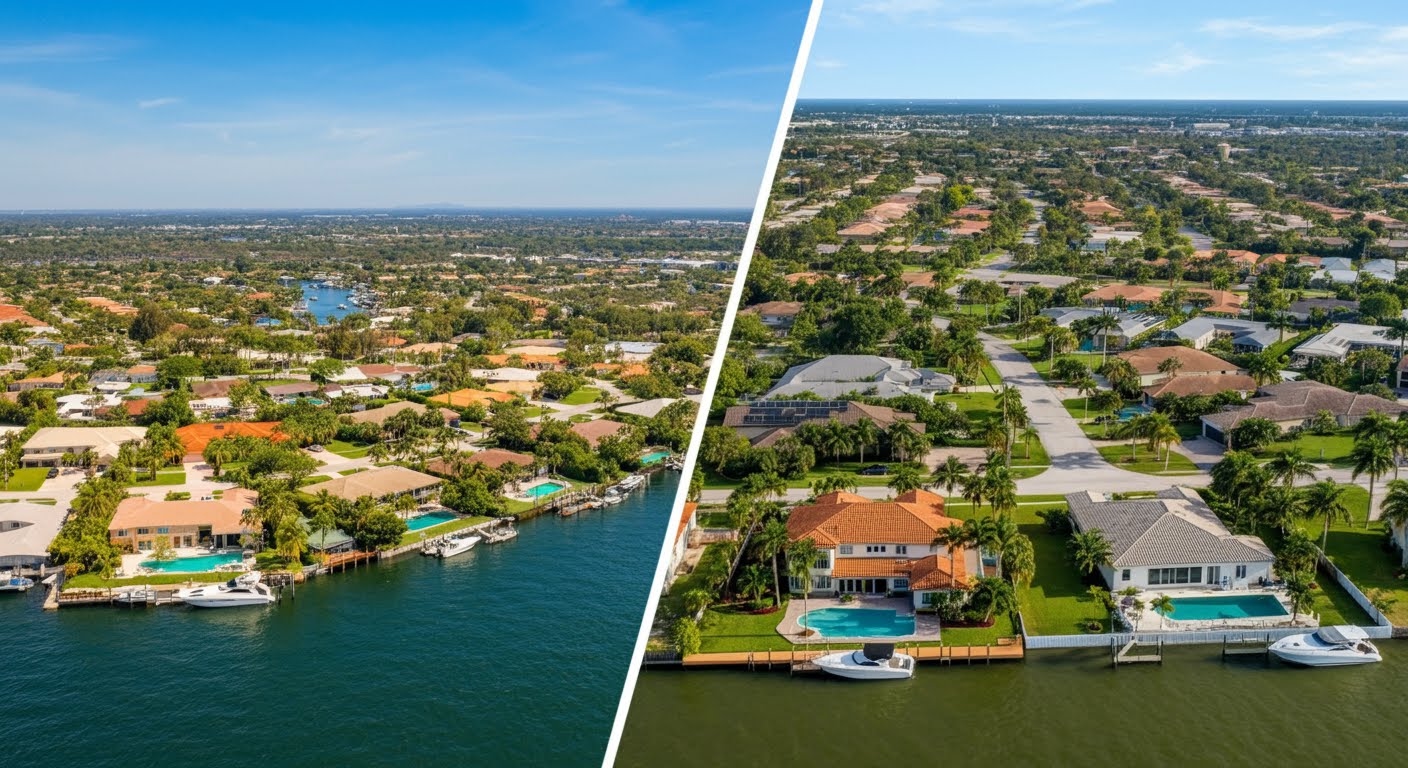
Buying Near Cape Coral Canals: Yacht Club, SE, NW, and SW Compared — illustrative photo
If you've spent any time looking at homes in Cape Coral, you've probably noticed that almost every listing seems to mention canals. What's less obvious from the listing photos is that Cape Coral is really four or five different markets stitched together by 400-plus miles of canals — and the differences between them, in price, insurance cost, boating reality, and resale behavior, are bigger than most out-of-area buyers realize.
This is a walk-through of how I'd think about the main canal micro-markets — the Yacht Club area, the older SE Cape neighborhoods around it, the newer SW Cape, and the NW Cape value belt — so you can match the right area to what you actually want out of a canal home.
In most markets, you pick a house and the location is a secondary filter. In Cape Coral, the canal your house sits on largely determines what the house can do — and what it costs to own. Two homes with identical square footage and finishes can have a $200,000 price gap because one has direct sailboat access to the Gulf and the other sits on a freshwater drainage canal with no navigational outlet.
Three variables drive most of the difference: navigational classification (Gulf access with no bridges, Gulf access through a lock, freshwater canal, or non-Gulf-access saltwater canal), flood zone and elevation, and how much of the surrounding inventory was rebuilt after Hurricane Ian. Get those three variables right for your use case and most of the rest takes care of itself.
The Yacht Club neighborhood is the original Cape Coral — platted in the late 1950s and early 1960s, closest to the Caloosahatchee River, and home to some of the shortest, cleanest runs to open water in the entire city. From most Yacht Club docks, you're in the river in minutes and out into San Carlos Bay without passing through a lock or under low fixed bridges.
This is reflected in the prices. The Yacht Club and the older SE Cape blocks immediately around it (Cornwallis, Coronado, Vincennes, Beach Parkway) carry the highest per-square-foot canal-front pricing in the city for any given lot size. You're paying for the access more than the house.
Two things to weigh honestly:
Resale in this pocket has historically been strong because the supply of true short-run Gulf-access lots is finite. If your priority is getting on the water fast and you don't need a 3,000-square-foot house, this is where I'd start looking.
South of Cape Coral Parkway and west toward the Chiquita Lock, SW Cape is where most of the higher-end newer construction has landed. Areas like Pelican, Caloosa, and the streets running south off Surfside have wider, deeper canals, larger lots (many 10,000-plus square feet), and a much higher share of homes built in the 2000s, 2010s, and post-Ian.
The trade-off relative to the Yacht Club area is the Chiquita Lock. Most SW Cape Gulf-access homes pass through this lock to reach the river. The lock itself is functional and generally not a deal-breaker for most boaters, but it adds time to your run, and the long-running political and permitting questions around the lock structure are worth following if you care about the answer. A marine contractor or a local boater can tell you what current cycle times look like.
What you get in exchange is space — larger pool decks, room for a substantial dock and lift, the ability to keep a bigger boat without bumping into your neighbor's seawall. Newer SW Cape homes are also more likely to be built to current wind code, which translates directly into better wind mitigation credits and a more reasonable homeowner's insurance bill.
Entry pricing here runs noticeably higher than the rest of the Cape for comparable square footage on Gulf-access water. If you want newer construction, a bigger lot, and you can live with the lock, this is the area that delivers it.
NW Cape is where the math gets interesting for buyers who care more about a water view, lower carrying costs, and newer construction than they do about reaching the Gulf in 15 minutes.
Large parts of NW Cape sit on freshwater canals — the spreader canal system feeding off Lake Finisterre and the surrounding waterways. These are great for kayaks, paddleboards, jon boats, and bass fishing. They are not Gulf-access. You cannot take a powerboat from a freshwater NW Cape canal to the Gulf without trailering.
What that buys you:
What it costs you: a longer drive to the popular SE waterfront restaurants, to downtown Fort Myers, and to the Gulf beaches. If you're a serious boater, NW Cape is probably not your answer. If you want a water view, a pool, a newer home, and a more manageable insurance bill, it deserves a hard look. More on the broader Cape Coral picture is on the Cape Coral area page.
Between the Yacht Club premium and the NW Cape value zone, there's a pocket of SE Cape that often produces the best dollar-per-square-foot deals: inland SE blocks on non-Gulf-access saltwater canals or freshwater canals, generally east of Del Prado and away from the river.
These homes sit on real water — wide, attractive canals with seawalls and the ability to keep a small boat at a dock — but the canals dead-end or connect only to other non-navigational waterways. You get the canal lifestyle (water view, fishing, kayak from your backyard) without paying the Gulf-access premium.
Buyers I've worked with who land here usually fall into one of two camps: they're not boaters and don't want to pay for access they won't use, or they're trailer-boat owners who'd rather drive to a ramp than pay the premium. In both cases, the math on monthly carrying costs is meaningfully friendlier than the same house on Gulf access two miles south.
If you are buying for the boat, three details matter more than the listing language:
Insurance is where the canal area shows up on your monthly statement for the next 30 years. In Lee County post-Ian, two homes a mile apart in Cape Coral can have insurance bills that differ by $4,000 to $8,000 a year based on flood zone, elevation, year built, roof age, and whether wind mitigation features are documented.
Yacht Club and direct-river SE properties tend to sit in Zone AE with significant flood premium exposure unless the home has been elevated or rebuilt post-Ian to a higher finished floor. SW Cape varies — newer homes built to current code with documented wind mitigation often come in lower than the older inventory around them. NW Cape freshwater areas frequently land in better zones, which is a real part of the value argument. Citizens Property Insurance is the backstop carrier for many of these homes, and Citizens-eligible properties have specific construction and elevation requirements that change what you can buy with what coverage.
Before you fall in love with any Cape Coral canal home, get an actual insurance quote for that specific address — not a generic estimate. Pull the elevation certificate if one exists. Ask when the roof was installed and whether a wind mitigation inspection has been done. These are the line items that determine whether a home that looks affordable on price is actually affordable to own. A current valuation framework for any specific address is on the home value page.
Here's how I'd think through it:
If you want to walk through your shortlist with someone who has been in and out of these neighborhoods for years, that's a conversation I'm happy to have — no pressure attached. You can reach out through the contact page or by phone or email directly.
Equal Housing Opportunity. Freddy Baez · Florida Broker BK3274734 · The Baez Collective at eXp Realty. Information here is general guidance, not legal, tax, or investment advice — please consult a qualified professional for your specific situation.
— Freddy & Josey
Frequently Asked
Explore These Cities
The SWFL Market Letter
Market notes and neighborhood reads from Freddy & Josey — written for SWFL homeowners, buyers, and the curious. No spam, no pressure.
Neighborhood Comparisons
A side-by-side look at Cape Coral vs Fort Myers vs Lehigh Acres to help you find the right fit.
Neighborhood Comparisons
A side-by-side look at Cape Coral vs North Fort Myers vs Lehigh Acres to help you find the right fit.
Neighborhood Comparisons
A side-by-side look at Fort Myers vs Cape Coral vs Naples to help you find the right fit.
Local team. Licensed in Florida. En español también.