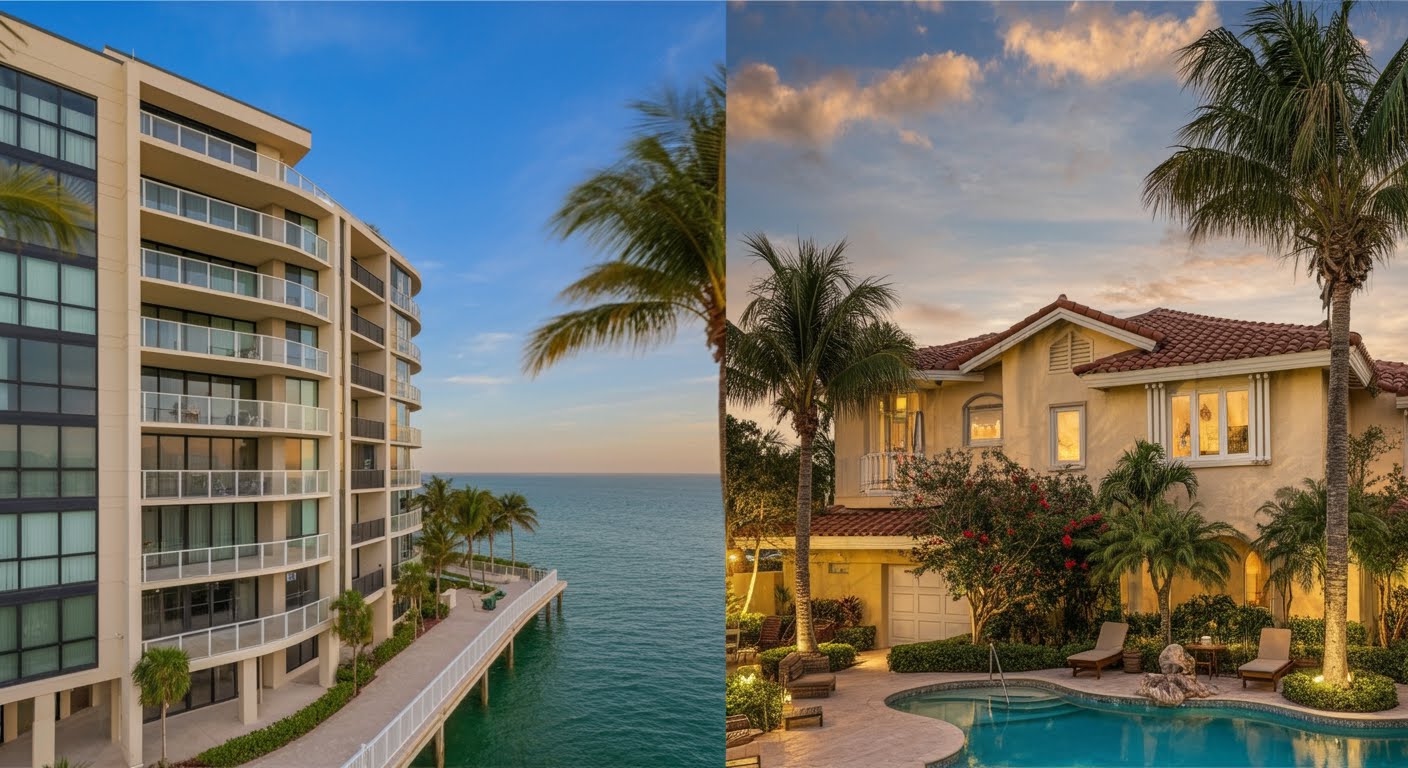
A Real Decision, Not an Obvious One
Most people assume the condo vs. house question is about price or maintenance preference. In Southwest Florida, it goes deeper than that. Florida passed major condominium legislation in 2022 and 2023 following the Surfside collapse, and those laws have changed the financial picture for condo ownership in ways buyers are only beginning to fully understand. Insurance markets, reserve fund requirements, and association governance all play a role in whether a condo makes sense for your situation.
This guide walks through the real differences — financial, legal, and lifestyle — so you can make a clear-eyed choice.
HOA vs. Condo Association — Not the Same Thing
People often use "HOA" as a catch-all for any community association, but there's a meaningful legal distinction in Florida.
A Homeowners Association (HOA) governs planned communities of single-family homes (and sometimes townhomes). The HOA typically maintains common areas — pools, gates, landscaping — while each homeowner is responsible for their own home's exterior and structure. Florida's HOA statute is Chapter 720.
A Condominium Association is different. Under Florida's Condominium Act (Chapter 718), the association is responsible for the entire building structure — the roof, exterior walls, elevators, hallways, and common elements. Individual unit owners own the interior of their unit and a proportional share of the common elements. This means the association's financial health is directly tied to your property's condition and value in a way that HOAs are not.
When you buy a condo, you're not just buying a unit. You're buying into the financial structure of the entire building. If the association is underfunded, deferred on maintenance, or facing special assessments, that affects your investment — and your ability to sell or get financing later.
Senate Bill 4-D and Florida's New Reserve Law
In the wake of the Champlain Towers South collapse in Surfside (2021), Florida enacted Senate Bill 4-D in 2022 — the most significant change to Florida condo law in decades. Every buyer considering a Florida condo needs to understand this law.
Milestone inspections: Condos that are 3 stories or higher are now required to undergo structural inspections at 30 years (25 years if within 3 miles of the coastline) and every 10 years thereafter. The inspector must be a licensed engineer or architect. If the inspection finds substantial structural deterioration, a more detailed phase-two inspection is required.
SIRS (Structural Integrity Reserve Study): Condominium associations for buildings 3 stories or higher must complete a Structural Integrity Reserve Study by December 31, 2024. The SIRS analyzes the remaining useful life and estimated replacement cost of key building components — roof, load-bearing walls, fire protection, plumbing, electrical, windows, and more.
Mandatory funding: Beginning December 31, 2024, associations can no longer waive or reduce reserve funding for structural components identified in the SIRS. Full funding is required. This is a sea change from prior law, where associations routinely voted to waive reserves — often to keep monthly fees artificially low while kicking maintenance costs down the road.
The practical effect: many condominium associations that were severely underfunded before 2024 are now issuing special assessments and/or raising monthly fees substantially to come into compliance. Before buying any condo in Florida today, you need to see the most recent reserve study and understand the association's current funding status.
Understanding Monthly Maintenance Fees
Condo monthly fees in Southwest Florida vary enormously — from under $300 for a small inland complex to $2,000+ for a high-rise luxury building on the Gulf. Here's what those fees typically cover and what to watch for:
- Included in most condo fees: Building insurance (the master policy on the building exterior), exterior maintenance, common amenities (pool, gym, community spaces), professional management, and a contribution to the reserve fund.
- Often not included: Interior unit insurance (you need an HO-6 policy), flood insurance (may or may not be in the master policy — ask specifically), cable/internet, and sometimes utilities depending on the building.
- HOA fees for single-family homes are generally lower — $100 to $600 per month in most SWFL communities — and cover common area maintenance and community amenities but not your home's structure.
Evaluate fees not just on the dollar amount but on what they're funding. A condo with $600/month fees that includes a fully funded reserve and comprehensive master insurance policy may be a better value than one with $350/month fees and a severely underfunded reserve — because the cheap one may hit you with a $20,000 special assessment in three years.
Financing Challenges for Condos
Getting a mortgage on a condo in Florida has become more complex. Conventional lenders (Fannie Mae and Freddie Mac) have added a conditional condo review process that flags buildings with certain characteristics:
- Deferred maintenance or outstanding milestone inspection findings
- Reserve fund below 10% of the annual budget
- Significant pending litigation against the association
- High percentage of investor-owned units (often a 50% limit)
- Short-term rental concentrations in excess of guidelines
If a building is on the Fannie Mae or Freddie Mac restricted/unavailable list, conventional financing isn't available — buyers may be limited to cash, portfolio loans, or non-QM products at higher rates. This directly affects your future resale pool as well.
Always ask your agent to check the condo's financing eligibility early — before you fall in love with a unit. This is especially important for older buildings (30+ years) and Gulf-front high-rises.
Lifestyle and Practical Considerations
The financial picture is important, but so is the lifestyle fit. Here's the honest comparison:
Condos make more sense if: you want low maintenance living (no yard, no roof, no exterior repairs), you're a seasonal resident who travels extensively, you want amenities without maintaining them, or you're targeting a specific price point in a desirable location where single-family homes would be out of range.
Single-family homes make more sense if: you want land and privacy, you have pets or vehicles with specific storage needs, you want control over your own exterior and renovation decisions, you're a full-time resident building long-term equity, or you have concerns about association governance risk.
Rental restrictions are also worth checking in both property types. Many condo communities in Southwest Florida restrict rentals — minimum 6-month or 1-year leases only, or no rentals at all. If rental income potential matters to your decision, confirm what's permitted before you buy.
What to Review Before Buying Any Florida Condo
- The most recent reserve study and current funding percentage
- The last 12 months of board meeting minutes (look for discussions of deferred maintenance, special assessments, insurance issues)
- The master insurance policy — specifically whether it includes flood coverage and what's covered vs. what your HO-6 needs to cover
- Any pending or threatened litigation against the association
- The milestone inspection status (if the building is 25–30+ years old)
- The percentage of owner-occupied vs. renter-occupied units
- Whether the building is on any lender-restricted list
Florida law requires sellers to provide condo documents within 3 days of an accepted contract. You have 3 business days after receiving the complete documents to cancel the contract for any reason. Use that review period seriously.
Not Sure Which Path Is Right for You?
The condo vs. house decision really comes down to your lifestyle, your timeline, and your risk tolerance — and in 2026, it also involves a careful read of the current condo market in light of the new reserve laws. Some condos represent great value. Others are carrying hidden liabilities that aren't obvious until you look at the documents.
If you want to walk through specific properties or communities with someone who knows this market, I'm happy to do that. There's no pressure and no obligation — just a clear conversation about what fits your situation.