Market Analysis
Cape Coral Real Estate Trends: Where the Market Is Heading in 2026
Data-driven analysis of the Southwest Florida real estate market.
8 min readMarch 25, 2026
Market Analysis
Data-driven analysis of the Southwest Florida real estate market.
New Construction Pipeline in Southwest Florida: What's Coming — The Baez Collective
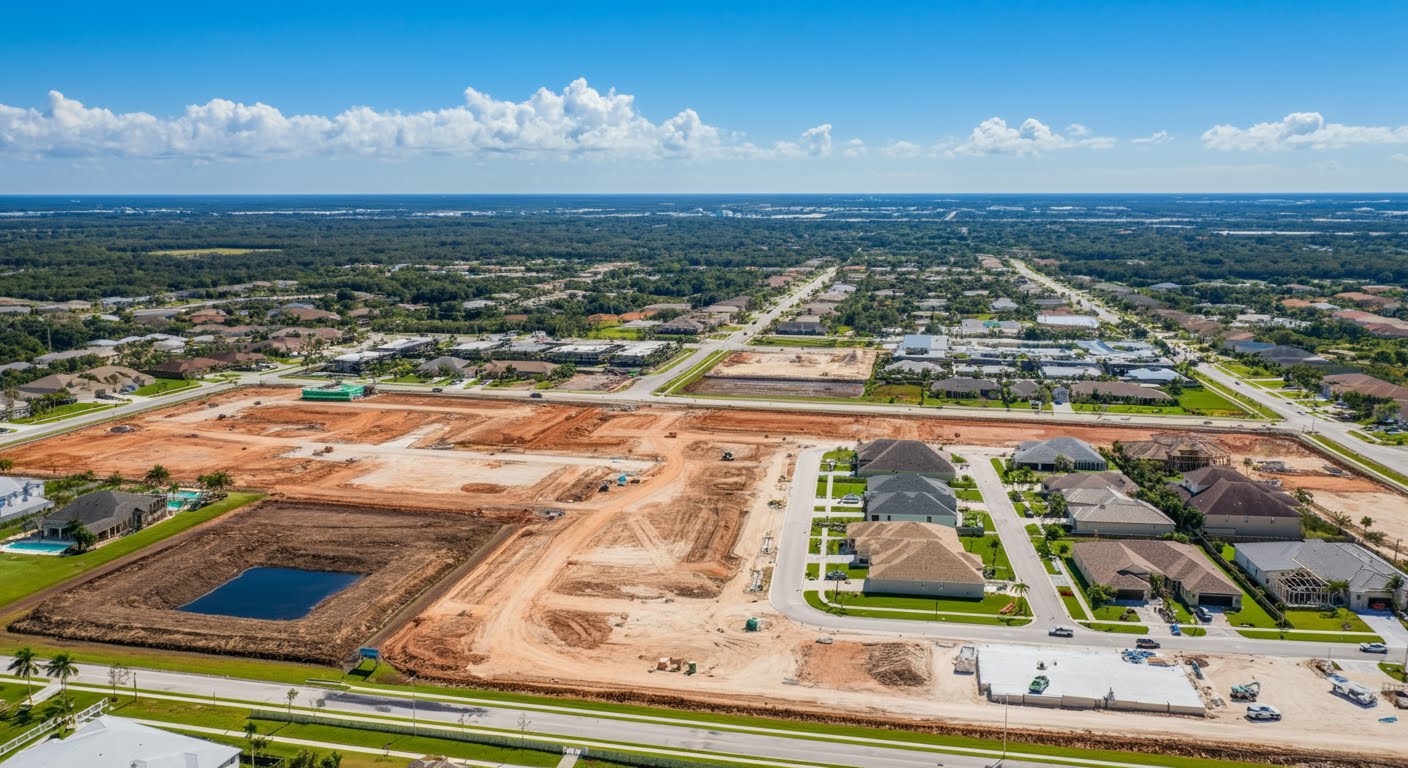
Southwest Florida has been one of the most active new construction markets in the United States for the past five years. Population growth, post-hurricane rebuilding demand, and the continuing migration of households from higher-cost states have kept builders busy even as the national new construction market has ebbed and flowed with interest rate cycles.
The data tells the story: Lee County has consistently ranked among the top counties in the nation for single-family building permit activity on a per-capita basis. Collier County's permit activity, while lower in volume, has included high-value luxury and mid-rise construction that elevates the total construction investment. Both counties entered 2026 with significant active pipeline — communities under construction, pre-sold inventory being completed, and new communities breaking ground.
Understanding what's in the pipeline matters for buyers considering new construction and for resale sellers competing against it. New construction in SWFL is not monolithic — it ranges from entry-level production homes in western Cape Coral to $5M+ custom estates in Quail West and Miromar Lakes.
The SWFL new construction landscape is dominated by a mix of national production builders and regional custom builders. Each plays a different role in the market:
DR Horton is the most active volume builder in Lee County, with communities concentrated in Cape Coral's western expansion areas and in the Fort Myers/Estero corridor. Their Express and Emerald series bracket an entry-to-mid price range, and their community amenity packages — pools, fitness centers, gated access — appeal to buyers seeking a turnkey experience. DR Horton has been particularly active in running mortgage rate incentives and closing cost programs, which can represent meaningful savings for qualified buyers.
Lennar has a significant presence across both Lee and Collier counties, with communities including developments in Bonita Springs and the Estero corridor. Their Everything's Included pricing model, which bundles features that other builders charge as upgrades, simplifies the comparison process for buyers.
Pulte/DiVosta has a strong presence in the 55+ and active adult segment, with communities including Cresswind at Lakewood Ranch and similar developments. Their communities tend to deliver polished amenity packages targeting the retirement and active adult buyer.
Babcock Ranch deserves specific mention as a unique development in Charlotte County that has drawn significant attention. Marketed as America's first solar-powered town, Babcock Ranch survived Hurricane Ian with minimal damage when surrounding communities sustained widespread destruction — a powerful proof point for its resilient infrastructure. New construction continues there across several builders and price points, attracting buyers interested in sustainability, community design, and demonstrated storm resilience.
Custom builders remain active in Collier County's higher-end communities — Quail West, Grey Oaks, Mediterra — where lot owners commission custom homes. This segment is insulated from production builder competition and operates on longer timelines with different buyer profiles.
Lee County residential building permits have moderated from the post-Ian peak but remain elevated relative to pre-2020 baselines. The recovery-driven permit surge of 2023–2024 — driven partly by rebuilding destroyed or damaged structures — is unwinding as that replacement demand completes. What remains is organic new construction demand driven by population growth and the ongoing migration into the region.
Collier County permits show a different profile: consistent volume with higher average values, reflecting the luxury and near-luxury composition of much of the county's new construction. Collier has historically had lower permit volume than Lee but higher per-unit value.
An important nuance: building permits don't directly equal new homes available to buyers. The lag between permit issuance and certificate of occupancy (the point at which a home can be legally occupied) runs 8–18 months depending on complexity. Today's permit data tells you about supply that will reach buyers in late 2026 and 2027 — useful for understanding future market dynamics but not the current inventory picture.
Community Development Districts are a financing mechanism common in Florida new construction communities. A CDD allows a developer to issue bonds to fund community infrastructure — roads, utilities, amenity centers — and then pass the debt service to homeowners through an annual assessment added to property taxes.
CDDs are not inherently negative. The infrastructure they fund is real and benefits homeowners. But they are frequently misunderstood or underemphasized in the new construction sales process. A CDD assessment of $2,000–$4,000 per year adds materially to your all-in housing cost. On a $400,000 home, a $3,000 annual CDD adds roughly $250/month to your true monthly payment — not trivial.
CDD assessments in Florida are public record and must be disclosed, but the timing and emphasis of that disclosure varies. Ask explicitly: does this community have a CDD? What is the annual assessment? How long does it run? Is the debt retired at a fixed point or does it reset? Some CDDs have 30-year terms; others are shorter. The difference matters for your long-term cost calculation and for the community's future resale competitiveness.
The new construction vs. resale decision is one of the most common questions buyers face in SWFL right now. Here's how to think through it honestly:
New construction advantages: modern floor plans and energy efficiency, builder warranties (typically 1/2/10 structure), current building code compliance, new roof and mechanicals, and builder incentives (rate buydowns, closing cost credits) that can be significant. The ability to select finishes — at some level depending on construction stage — is also a draw for buyers who want personalization.
New construction limitations: CDD fees, HOA fees that include amenity costs that not all buyers value, construction timelines that extend your uncertainty window if you need to be somewhere by a specific date, and the reality that new communities lack the established trees and landscaping that make older neighborhoods feel settled. Location is also often a trade-off — new construction concentrates in areas with available land, which in Lee County means western Cape Coral and the Estero/Bonita corridor, not necessarily the neighborhoods with the best commute or proximity to specific amenities.
Resale advantages: established neighborhoods, known insurance costs (you can verify before buying), immediate occupancy, and often more location flexibility. The primary disadvantage is age — older roofs, older mechanicals, and the need to verify condition carefully.
The right answer depends on your specific priorities. Neither option is universally superior.
Ready to learn more about Southwest Florida? Check out these resources:
— Freddy & Josey
Frequently Asked
Explore These Cities
The SWFL Market Letter
Market notes and neighborhood reads from Freddy & Josey — written for SWFL homeowners, buyers, and the curious. No spam, no pressure.
Market Analysis
Data-driven analysis of the Southwest Florida real estate market.
Market Analysis
Data-driven analysis of the Southwest Florida real estate market.
Market Analysis
Data-driven analysis of the Southwest Florida real estate market.
Local team. Licensed in Florida. En español también.